I hadn't paid much attention to naval miniature games so far, being mostly interested in ground-based skirmish games (whether fantasy or sci-fi.) This changed after a friend of mine commented about a soon-to-be-released fantasy naval wargame by a well-known law firm that also makes miniature games on the side. This made me want to find alternatives to that game that I could suggest to him.
So after looking for reviews on the internet, I found this interesting post about the game called "It Is Warm Work" which seemed to be newbie-friendly enough. I got it in PDF form and started reading. Since the rules are only a dozen pages long, I was quickly done and eager for a playtest. This led to the problem that I don't have any miniature "age of sail" ships (or any ships, for that matter.) The author of "It Is Warm Work" states that different miniature scales can be used but suggests 1:2400 ships placed in 1"x2" bases. Since I couldn't find any ship counters on a quick search on the internet, I made my own. You can click on the image to the right to get them at 300dpi, printable in A4 or Letter sheets. In my case, I printed them on a sheet of 120gsm paper and glued it to heavy cardstock.
After printing these and the playing aids and status markers that come with the book, I was ready for my first "naval action." It must be noted that I have pretty much no knowledge of sailing, naval miniature games or the history of the age of fighting sail. Therefore, I had to look up sailing terms such as "in irons," as well as learn more about fire ships (I never imagined that there were ships purpose-built to be set in flames as a tactic,) the line of battle, ships-of-the-line, prize crews among others. That is the downside of a slimmed down rule book -- it will inevitably rely on more prior knowledge from the reader. Anyway, good old Wikipedia was more than enough to give me pointers on the subjects.
Instead of trying to build a complete scenario I just placed a line of four class-B 74-gun ships on one side (thus dubbed "team A") against three class-A 74-gun ships on the other (which will be "team B",) with the wind initally favoring the side with less ships. My first playtest was a delightful session where I learned that maneuvering sailing ships is not like moving infantry or vehicles... after putting team A's first ship in irons and nearly dismantling team B's line, all in the first turn, I decided to start over.
The second time around, I managed to make more sensible actions. In the first exchange of fire between the ships, team B caused severe damage to team A's first ship, almost destroying it (note: in this picture I moved the wind arrow to maneuver the ships. In the future I might simply pick one of the board edges as the direction of the wind as suggested in the book.)
A couple of turns later, most ships had taken at least some damage, but team A was in worse condition, with one ship nearly destroyed and another one impaired.
Eventually the first ship from team A struck her colors and since two other ships were crippled, I decided it was a victory for team B, through a combination of sturdier ships and some luck in the attack rolls. The entire battle with seven turns lasted about 50 minutes, part of that due to my constant checking of the book as I learned the rules. Bookkeeping was minimal, with a one-line damage track per ship. Playing with ship counters was surprisingly satisfying as I could stack the status markers on top of them.
Conclusion
This little experiment raised my interest in naval miniature games. I guess I must thank my friend for unknowingly leading me to a great set of rules and making me find a new type of game that I enjoy. "It Is Warm Work" is designed for large fleet battles and seems to do its job very well. I'm curious now about other rules sets for only a handful of ships, that might add detail that would be unwieldly in this scale.
Incidentally, all the simulation aspects that get into naval miniature gaming -- especially the maneuvering of the ships -- made me think that this (or maybe spaceship miniature games) might be the answer to another question that has been pestering me: how can I have miniature games that do not revolve around combat? I'll try to write a fictional scenario for It Is Warm Work involving some sort of rescue, drifting ships and a coming storm...
Sunday, October 16, 2011
Saturday, October 15, 2011
Modular 15mm terrain - take two
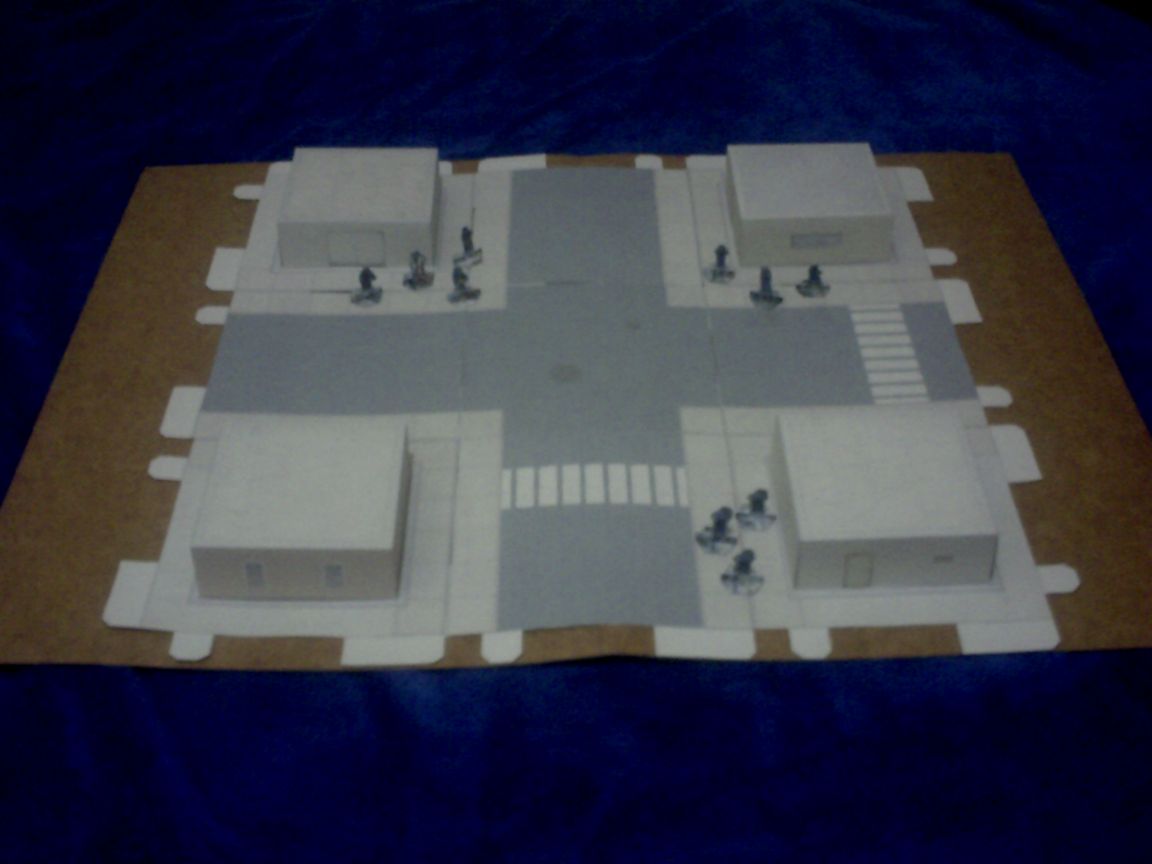
So in preparation to run some 5150: New Beginnings I have gone back to creating some modular urban 15mm terrain. Each tile is 6"x6", allowing a variety of streets and blocks configurations. The buildings fold flat. The files may be obtained on this thread of the Cardboard Warriors forum. Here are some pictures of the results, printed in economy mode on gray paper.
A closer look on one of the buildings. While the streets and sidewalks look good enough in economy mode, I might end up printing the buildings again in normal setting. On the other hand, this "washed out" look makes the minis stand out.
Here's a shot with a few miniatures (from Precis Intermedia) printed in reduced scale to be used as 15mm. The tiles are connected to each other through a simple system of tabs. The buildings are slotted into the tiles so that they don't move around too.
And another shot to show a bunch of minis on the board, to get a better sense of scale. For a proper game, I think I still have to print some more tiles, to get a 2'x2' area at least. For learning the rules, this will certainly do.
The tiles are a little annoying to put together but the tabs solve the problem of having them easily moving around while playing. An alternative would be to glue each tile to a piece of thick cardboard or foamcore but then another method of slotting the buildings into the tiles would be needed.
A closer look on one of the buildings. While the streets and sidewalks look good enough in economy mode, I might end up printing the buildings again in normal setting. On the other hand, this "washed out" look makes the minis stand out.
Here's a shot with a few miniatures (from Precis Intermedia) printed in reduced scale to be used as 15mm. The tiles are connected to each other through a simple system of tabs. The buildings are slotted into the tiles so that they don't move around too.
And another shot to show a bunch of minis on the board, to get a better sense of scale. For a proper game, I think I still have to print some more tiles, to get a 2'x2' area at least. For learning the rules, this will certainly do.
The tiles are a little annoying to put together but the tabs solve the problem of having them easily moving around while playing. An alternative would be to glue each tile to a piece of thick cardboard or foamcore but then another method of slotting the buildings into the tiles would be needed.
Saturday, October 8, 2011
Creating a bad neighborhood on the cheap
After Slorm's comment about the paper buildings on my previous post, I thought it might be useful to someone in need of some urban terrain done quickly and quite cheaply. It might be useful as an activity for kids, too.
Everything starts with a template. The idea is to build a box with five sides. You want to have some tabs on the open side to help keeping the building walls straight -- especially if you're using common scratch paper like me. The template is simple enough to draw by hand with ruler and squares but if you want to make several buildings, it may be worth to print the template (I have a couple at the end of this post.)
In my case what I do is to print just the outlines in "fast economy" mode and draw the details. Alternatives include drawing some basic outlines like doors and windows on the template before printing, maybe even some rough coloring (be sure to use some "economy" mode or you'll miss the point of keeping these cheap) or printing in colored paper.
Everything starts with a template. The idea is to build a box with five sides. You want to have some tabs on the open side to help keeping the building walls straight -- especially if you're using common scratch paper like me. The template is simple enough to draw by hand with ruler and squares but if you want to make several buildings, it may be worth to print the template (I have a couple at the end of this post.)
In my case what I do is to print just the outlines in "fast economy" mode and draw the details. Alternatives include drawing some basic outlines like doors and windows on the template before printing, maybe even some rough coloring (be sure to use some "economy" mode or you'll miss the point of keeping these cheap) or printing in colored paper.
Friday, October 7, 2011
Modern Havok
While I waited for 5150: New Beginnings (which is now printed and bound and I just need some time to read,) I started looking for other Two Hour Wargames (THW) products. The pulp-era games are interesting but I still have to prepare a minimum set of minis and terrain for that period before I decide to get those rules. So I found Modern Havok, a rules set written by Ed Teixeira for Rebel Minis.
Modern Havok is quite similar to Chain Reaction 3.0 but with differences (some of them subtle) that make the game simpler and possibly faster and more lethal. For instance, Stars aren't so tough and there aren't as many states a figure may be in (like Hunker Down etc.) Melee combat is also different, and most of the time faster.
For me, the three scenarios at the end of the book (Liquor Store Holdup, Man Hunt and Raid) make it worth. Lots of good ideas, like the Draw Down system for resolving an armed "face off" between opposing groups, reaction to police arrest attempts and a way to simulate a larger battlefield in a 3'x3' table.
I ran a quick test scenario with these rules. It was also a chance to try some hand-draw buildings I've been fiddling with (in preparation for some improved versions.)
In this scenario, I controlled a group of four gang members: a rep 5 star with a BA pistol, two rep 4 thugs with shotguns hidden in their trenchcoats and one rep 3 guy with a machete and pistol. They were looking for some members of a rival gang in a run down area of the city. There were some civilian groups scattered about and I placed three markers that might be the location of the rival gang. I also established that if I rolled a sum of 10+ on the activation rolls, an ambush would occur with 1-3 enemies appearing from each end of the "street."
I used the marker movement system from the Raid scenario to move the gang markers. If a marker came into sight I would roll a die to check if it was a group of civilians (1-3) or the rival gang (4-6) consisting of 2-6 members. Upon finding the gang, the other unresolved markers would be removed.
During the game, the rightmost marker (on the above picture) turned into a group of three rep 4 gangers. The leader was armed with a semi-automatic rifle and the two others carried pistols. I used the Draw Down mechanic (from the Liquor Store Holdup scenario) to have both groups see each other and react drawing their guns. The enemy gang fired first but missed. The two thugs with shotguns on my group ducked back behind the two-story building and my star stunned the enemy leader. Using the "flock of seagulls" mechanic, one of the civilian groups retired from the table while the other two ducked back behind buildings.
On the following turn, my group advanced and the enemy didn't roll well on their In Sight reaction to my thugs leaving the cover of the building. This allowed them to fire again, taking all three enemies out of the fight. The civilians remained ducked back as the firefight continued and my gang members, having dealt with their target, ran away before other threats would arrive.
Modern Havok is quite similar to Chain Reaction 3.0 but with differences (some of them subtle) that make the game simpler and possibly faster and more lethal. For instance, Stars aren't so tough and there aren't as many states a figure may be in (like Hunker Down etc.) Melee combat is also different, and most of the time faster.
For me, the three scenarios at the end of the book (Liquor Store Holdup, Man Hunt and Raid) make it worth. Lots of good ideas, like the Draw Down system for resolving an armed "face off" between opposing groups, reaction to police arrest attempts and a way to simulate a larger battlefield in a 3'x3' table.
I ran a quick test scenario with these rules. It was also a chance to try some hand-draw buildings I've been fiddling with (in preparation for some improved versions.)
In this scenario, I controlled a group of four gang members: a rep 5 star with a BA pistol, two rep 4 thugs with shotguns hidden in their trenchcoats and one rep 3 guy with a machete and pistol. They were looking for some members of a rival gang in a run down area of the city. There were some civilian groups scattered about and I placed three markers that might be the location of the rival gang. I also established that if I rolled a sum of 10+ on the activation rolls, an ambush would occur with 1-3 enemies appearing from each end of the "street."
I used the marker movement system from the Raid scenario to move the gang markers. If a marker came into sight I would roll a die to check if it was a group of civilians (1-3) or the rival gang (4-6) consisting of 2-6 members. Upon finding the gang, the other unresolved markers would be removed.
During the game, the rightmost marker (on the above picture) turned into a group of three rep 4 gangers. The leader was armed with a semi-automatic rifle and the two others carried pistols. I used the Draw Down mechanic (from the Liquor Store Holdup scenario) to have both groups see each other and react drawing their guns. The enemy gang fired first but missed. The two thugs with shotguns on my group ducked back behind the two-story building and my star stunned the enemy leader. Using the "flock of seagulls" mechanic, one of the civilian groups retired from the table while the other two ducked back behind buildings.
On the following turn, my group advanced and the enemy didn't roll well on their In Sight reaction to my thugs leaving the cover of the building. This allowed them to fire again, taking all three enemies out of the fight. The civilians remained ducked back as the firefight continued and my gang members, having dealt with their target, ran away before other threats would arrive.
Sunday, October 2, 2011
Exterminator Jack
Here's the model I created for the Papercut Awards 2011. Since the contest is over, I thought I'd post the model here. It's a 28mm scale 2.5D multi-part model that I named "Exterminator Jack." Equally fit for a zombie apocalypse or post-holocaust sci-fi setting, with his plasma thrower. Some textures were obtained from cgtextures.com and the figure was drawn in good ol' Gimp.
Here is the printable sheet in 300dpi. The red lines indicate places that should be scored and folded. For a great paper modeling guide, check this link (Dave's Games) at the top of the page.
Subscribe to:
Posts (Atom)