Showing posts with label first impressions. Show all posts

Monday, June 13, 2016

Blast Pistol

It seems shaking my habit of buying rule sets is harder than I thought, as I have added a few to my collection, including Blast Pistol. This is the new game from Nordic Weasel, and intended for quick pick-up games in sci-fi settings.

One interesting thing about Blast Pistol is that it is published as a "living rules system", meaning it will be updated as time goes. Right now the rule book is very bare-bones, and I would normally be wary of this proposition (having purchased rules that were later abandoned in a bad state by other authors). However, considering how Five Core has evolved in a relatively short time, I think it will work well.

Right now, Blast Pistol is a very simple rules system, with an alternate activation turn sequence in which players select and activate a number of units at a time. Miniatures are single based and grouped into squads or act as individuals. There are some unit templates for squads, heroes and vehicles. The writing is clear but since the document is very concise, it requires attention. For instance, in my first read I was hunting for the definition of damage in vehicles, which is presented in a bullet point on the section about big models.

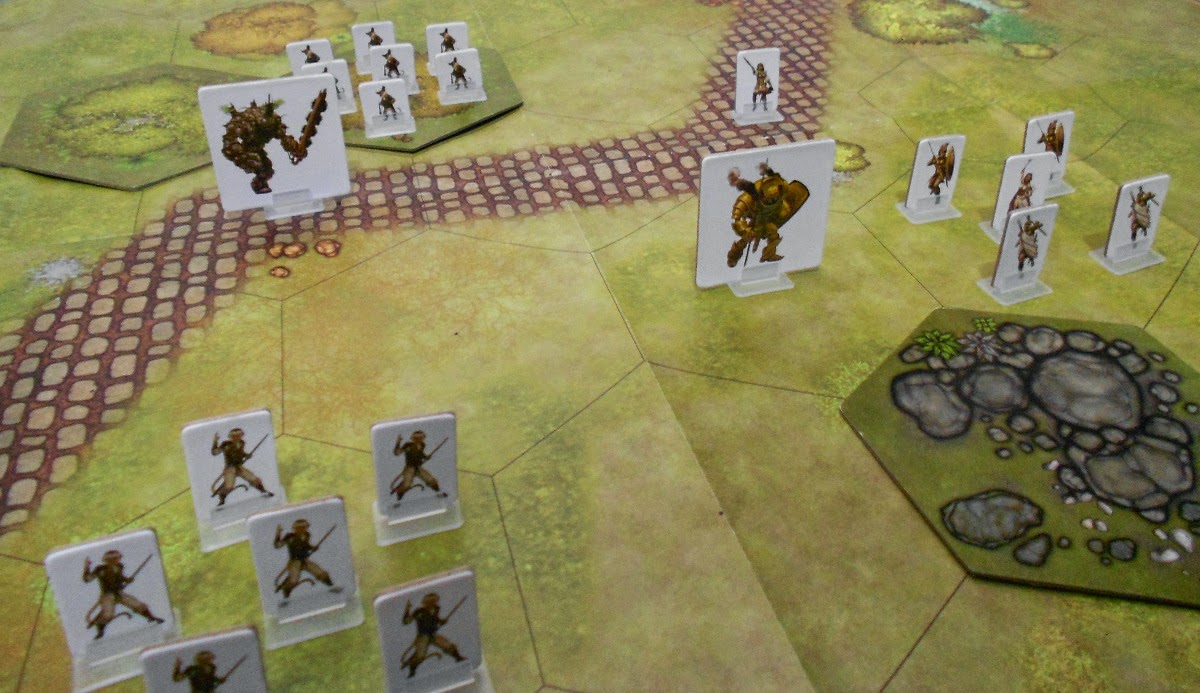
As a pick-up game, battles are played as meeting engagements, fighting four turns and counting how many points in units each player has destroyed after that. Here is one simple example with balanced forces: on one side, three colonial militia squads, a gunsliger and a hero (302 points) against 3 precursor squads (300 points).
Board setup: a virtual 4'x4' table with some obstacles. Precursors at the bottom of the image, colonial forces at the top. The grey patches are rock formations that are impassable and block line of sight.
Turn 1: the colonial forces go first but don't kill anything. The precursors cause damage to one of the colonial militia squads.
Turn 2: colonial forces keep advancing and the hero and gunslinger move. In the exchange of fire, both sides lose some units.
Turn 3: the colonial forces move to a position where they can fire more effectively, but miss most shots. The precursors are then able to shoot back and cause lots of damage. Two colonial squads flee the battlefield.
Turn 4: the precursors defeat the gunslinger and hero. The last colonial squad only hits one enemy. The game ends with a clear victory for the precursors.
After this battle, I played again two more times (that is the beauty of a virtual tabletop: you can set up a scenario, save it and then quickly replay it several times.) On the second, the precursors won by 146 vs. 120 points (point costs of defeated enemies.) The third was also won by the precursors, 210 vs. 120 points. I guess the terrain favored the longer range of the precursor weapons, although I also had some terrible rolls for the colonial forces.

These are only my first impressions, as I have not tried battles using vehicles or other big models. I also want to try other board sizes and setups. So far, it seems to work well for quick games. Based on the rules for activation and morale, I think smaller squads (of 4-5 troops) are better than larger ones.

There are no solo rules, and I do not think this game is aimed at solo play. That said, I think it would be simple to adapt the solo rules from Five Core or No End in Sight if one wanted to.

Sunday, June 5, 2016

The ruins of Algor'nas: a 4 Against Darkness adventure

I picked up 4 Against Darkness (by Ganesha Games) a few weeks ago and played my first adventure this weekend. My party of four adventurers consisted of the following, in marching order:

Stegmo: level 1 warrior, equipped with light armor, mace, shield. Carrying 1 bandage. 7 life.
Kernas: level 1elf, equipped with light armor, sword, bow (default). Spells: blessing. Carrying 1 bandage. 5 life.
Abugol: level 1 wizard, equipped with a dagger and spell book. Carrying a lantern, 1 bandages and 10 gold. Spells: 3x fireball. 3 life.
Sharnas: level 1 rogue, equipped with a sling (default), dagger, light armor and lock picks. Carrying 1 bandages, rope and 10 gold. 4 life.

The entrance to the dungeon was a large room with two doors and a poorly lit corridor. Before trying the doors, the adventurers decided to move down the corridor. They found a closed door and beyond, another room with an alchemist in it. They did not have enough gold to purchase the strange potions he had, and so he moved on.
Starting a dungeon. I opened the provided graph paper template in Gimp and scribbled the rooms there.
They opened the next door to find a weird bug-like creature with four claws, dripping a green goo from its mandibles. "Iron-eater!", Stegmo shouted and leaped at the creature, hitting its head with his mace. Kernas hit a weak spot of its carapace with an arrow, and Sharnas exploded one of its eyes with a good sling toss. The monster dropped to the ground. After the fight, Kernas found a magic sword that somehow was not eaten by the monster. [Besides finding the treasure, Kernas gained a level.]

Saturday, May 14, 2016

Tone Pulsar and the missing com-link

I have just finished playing my first adventure using Future Tales by Two Hour Wargames. Here is the report, followed by some first impressions about the game.

I started by creating my Star, and then recruiting (rolling) a co-star and grunt to help:

Tone Pulsar / Rep 5 Star / Human Male
Star power: 4 (base 5)
Attributes: Nerves of steel, Pilot
Class: Adventurer / Circle: Exotic (SS 3) / Profession: Pilot
Weapons: Laser pistol, shock dagger
Home: Office at the commerce area of Starlis station, orbiting planet Gablum

Yeerox / Rep 3 Co-star / Klorian Female
Attributes: Genius, Tough
Class: Civilian / Circle: Civilian / Profession: Merchant
Weapons: Laser pistol
*Klorians are a humanoid alien race with bat-like heads and furry skin.

Ingrid / Rep 3 Grunt / Small human Female
Attributes: Initiative, Slight
Class: Criminal Element / Circle: Criminal / Profession: Thief
Weapons: Knife

A bit of invented lore
The post of Free Agent was created after the Galactic Empire was forced to admit that there was just too much going on for the imperial forces to handle. An Imperial Free Agent is granted a limited amount of power to conduct investigations on the Empire's behalf in distant sectors of the galaxy. They are allowed to form an agency and hire deputies and assistants. In practice, investigations often turn into conflicts with local crime lords, which the Empire is glad to ignore.

The Missing Com-link


Lieutenant Wilka came looking for help after she and friends were attacked while on leave. She had her com-link stolen, and it held some intimate pictures. That is why she came to the agency: she wanted it solved before any of it reached the galactic network. The incident happened on the space station orbiting planet Kerris, and so that was Tone's first stop.

[I rolled a "Find object" mission requiring 3 clues. The "Big Bad" class was Royal Pain, which became Baron Brezal (Rep 6 noble)]

Retro-futuristic rocket approaching a planet.
[Source: https://openclipart.org/detail/214100/sci-fi-rocket-and-planet]

Scene 1
Planet Kerris / Space station Morgane / Quarters

Tone and crew flew on their agency spaceship to Space Station Morgane, orbiting planet Kerris. During their travel, Yeerox found out that a security engineer might have footage of the assault against Lt. Wilka, so their plan was to look for him. They arranged a meeting at an electronics supply store in the quarters sector of the station -- a place that should be safe.

The store was empty when they arrived -- a trap. Three large guys carrying heavy guns surrounded them: two coming from the storage area and one closing the front door. Tone tried playing the "free agent" card and it paid off: the thugs admitted working for Baron Brezal, who apparently didn't pay them too well. From what they said, Brezal had ordered the attack after Lt. Wilka had ignored his advances. A petty motive, but not surprising for local nobles.

[Still, this scene was a failure as they didn't gain a clue about the object.]

Saturday, May 7, 2016

Battleblade: first impressions

I recently purchased Battleblade by Echidna Games. It is a fast and simple rules set for fantasy skirmish battles. The author notes that Song of Blades and Heroes was an influence, and it does share the feature of having a short stat line and special rules (abilities) for figures.

The game uses an IGOUGO turn system, with limited number of activations per turn. There are no reactions, but to be honest I do not think those are so necessary in medieval fantasy battles (as opposed to modern or sci-fi battles.)

Most actions are resolved with a single roll with a few modifiers, and there is little need for status markers on the table. Since figures can have various abilities, a roster sheet or some unit cards will probably be helpful for players.

The rules are easy to learn -- furthermore, they are very well organized and clearly written. The book also features pictures at the right places, serving as welcome examples, and I think this must be one of the most newbie-friendly miniature game books around. It assumes very little from the reader, states things clearly, shows many examples and has a decent glossary and turn flowchart (even though the turn sequence is quite simple.)

One interesting bit is that the game is written for 54mm scale miniatures mounted on 50mm round bases.  The larger scale makes the recommended table size 4'x4', but it also means that it is possible to play with 28mm scale miniatures mounted on 25mm round bases on a board as small as 2'x2'. I played a few test battles on MapTool to learn the rules and it worked well.

A test battle between 100-point forces in Battleblade, in a simulated 2'x2' board with 28mm miniatures
And what about solo play? The rules do not mention it, but I think it would not be hard to include ideas from Featherstone's books or from other rule systems, given the simple turn structure and combat rules. In fact, setting a goal for the enemy band and using "blinds" before enemy contact might be enough for basic solo play with this game. However, I still have to try that.

Conclusion
My first impression of Battleblade is that it is a good introductory miniatures game. It plays quickly and it is not difficult to pick up a figure and build its profile to use in the game. There are other game systems with similar purpose, but at its low price, it might be worth looking.

Saturday, January 16, 2016

Fringe Space: a short playtest review

This is my first adventure using Fringe Space, a "lite RPG" from Two Hour Wargames. Essentially, you control a small band of characters going from planet to planet in the 5150 universe, doing legal and illegal jobs.

As in 5150 Urban Renewal, your goal is to gain enough during your career to be able to have good life once you retire. Indeed, Fringe Space is like a toolbox with bits from Urban Renewal, New Hope City: PI, and Larger than Life. There are nice ideas to move the campaign forward and combat, when it happens, is a lot more abstract than in other miniature games.

Using the character creation system I rolled my main character and added two companions. Winston is an investigative reporter selling holo-vids about corporations (projects, conflicts etc.) to Gaea Prime networks. He also performs smuggling and information theft jobs for select customers. Pingh is his assistant, operating the holo-vid equipment and Axor plays bodyguard for both of them. Actually, he is somehow indebted with Pingh... good luck prying into a Grath's personal matters. All of the three carry big-*** pistols and wear body armor.

Winston (center), Pingh and Axor
Winston - Rep 5 star (25 years old Basic male)
Investigative reporter (Mercenary / social standing 3)
Charismatic, Coward, Resilient
Home world: 3rd ring, 5th sector, class 1 planet, law level 4
Family ties: 24 year old female sister
BAP, Body armor

Pingh - Rep 3 grunt (32 years old Hishen male)
Initiative, Brawler, Slight
BAP, Body armor

Axor - Rep 4 grunt (33 years old Grath)
Brawler, Brick wall, Initiative
BAP, Body armor

Information Brokering

Winston was on a settlement on the Groff planet, on the 5th sector of the 4th ring -- the outskirts of Gaea Prime domain. He arranged a lunch meeting with an information dealer at a restaurant in a mid-level neighborhood -- alone. On his way, using the public transportation system, he met Alys [basic female, 25 year-old, rep 4, resilient, brawler, poser], a medical tech operator. He got her comlink ID in case he might need to hire someone with medical knowledge.
[I rolled for the two possible enemy forces (PEFs) on the way to the encounter; the first was this NPC, and Winston succeeded at a Talk the Talk test. The second one was nothing.]

Monday, December 7, 2015

A solo review of War Story

War Story is the most recent title from Nordic Weasel Games (NWG). It is a mix of story generator and light, story-oriented rules for miniature games. Due to its nature, it is presented as more adequate for cooperative or solo play. For these reasons, I could not resist the urge to pick it up and give it a try.

When I got the PDF book, I was mostly curious about the narrative rules system. Other titles from NWG have campaign generators that work well, and I assumed that some of that expertise would be applied in this title, too (spoiler: the book does contain a scenario generator.)

The text starts in a very general tone, discussing possibilities and play styles for the game. It sounds like a "meta description" of miniature games, and I suppose the decision to write it this way was to have a core set of rules that may be further expanded. This also means that newcomers to miniature games will probably end up reading through the book more than once or looking for tips elsewhere to figure out what options to use.

The action resolution system reminded me of the task system from Five Core, extended to deal with different situations during the game. Combat is similarly resolved with a single roll, as the level of detail here is that of narrative events, not recreating each moment of a firefight. There is also a system to answer general questions about the scenario, which is like a simplified Enquiry Table.

But how does it play?
Having read through the 27 pages of the book, the next step was to play a game to find out how it feels. There is no set scale for the game; instead, it is one of the things that players must define. I liked the insight that ground scale and time scale are tied together by the standard movement rate of units; while not stated, this is what is going on.

In this scenario, an invading force (on the left) must attack and destroy the defenders' outpost. The invaders have two regular squads, an infiltration team and an assault squad who are in charge of destroying the target. The defenders have three regular squads. One is guarding the outpost, and the other two are on patrol. Each figure represents two soldiers.
Setup for the test game.

Thursday, November 26, 2015

First impressions: Savage Worlds Showdown for solo play

Recently I read and played a bit with Savage Worlds Showdown, the free set of miniature rules based on Savage Worlds RPG. It is available as a PDF book 44 pages long and very well produced.

Miniatures are grouped into units, and the game assumes most of a player's force will be organized this way, although it is also possible to have single miniatures acting independently -- usually heroic figures, or "Wild Cards." Each unit or figure has a number of traits and skills, adapted from the role-playing game, which are rated in terms of dice size, e.g. Agility d8. Action resolution involves rolling one or more dice against a target number, and on a few occasions players roll against each other.

There is also a handy unit builder spreadsheet to calculate point values for different figures and groups. Even those not inclined to use point systems may use it to get a feeling of how to build new profiles, based on the samples included. The upside is that units can be varied and detailed; the downside is that setting up a force takes some time.

Although the game does not provide any rules for solo play, it does have a number of features that make it suitable for that purpose. Specifically, I would highlight the following:

  1. The rules for "rogues", figures that act independently of the players and may attack anyone, may also be used as a basis for a simple "artificial intelligence" for automated enemies.
  2. The card-based activation system provides an order of activation of units, thus removing the need for a solo player to select which enemy to activate.
  3. The "fortune and calamity" system adds random events that are welcome in solo play, as they provide another source of uncertainty.
On the other hand, there are a few problem points in adopting these rules to play alone. Here are the ones that drew my attention and some proposals to handle them:
  1. The choice of when to use "bennies" can be problematic. Removing them altogether is probably not the best option, unless playing a "gritty" scenario. My approach is to roll a six-sided die to decide if a "benny" should be spent. If the roll is equal to or lower than the current number of available "bennies", then it is spent. Subtract 1 from the roll if the "benny" would be used for a soak roll of a Wild Card.
  2. The choice of when to hold an action can also be problematic. One option is to simply remove this action from the game. An alternative is to judge the option to hold an action as one would consider the option to set a unit on overwatch in other games, e.g. if it would benefit from guarding an area.
In my test games, combat with modern weapons was very lethal: a single pistol shot is quite likely to take down a figure, and smaller units soon start suffering morale effects. Therefore, a large table with lots of terrain is recommended.

Conclusion
My initial impressions of Savage Worlds Showdown are positive. It may take some time to build the unit cards but the game flows quickly, with a simple turn sequence and combat resolution. The trait and skill rolls are very flexible and might be used for battles with role-play and stunt elements. It is worth a try for those interested in an alternative for large skirmish games (say, up to platoon size). It might also work with a handful of Wild Cards fighting each other, but I have not tried that. Although the system does not include support for solo play, it is not hard to adapt it.

Saturday, November 21, 2015

Breaking through!

While I was looking at my collection of rules, I found out that I had never tried the Gunstorm solo skirmish rules by Spacejacker. So I picked up some miniatures and set out to do that. Instead of chits for phases and wounds, I used cards from a common deck. Not as simple to manipulate as I had to keep shuffling the wound deck, but usable.

In my trial games I just used two squads of regular soldiers with light armor, assault blasters and no stunts [other stats were Shoot +2, Fight +2, Sprint 0]. The enemy squad must break through my defenses and escape through my board edge.
Enemy on the left, my squad on the right.

In the first game, I forgot to roll the guts saves when a model was hit. This, combined with drawing only "dead" counters, resulted in a very lethal game. The enemy crossed the bridges but was defeated before escaping. The game played in 15 minutes or so, and this made me want to play a bit more.

In the second game, the guts save rolls made the enemy survive longer, and they even killed more of my troops, but in the end, did not complete their objective.

For the third game, I decided to use Aleksandar's alternate wound resolution, presented at the end of his battle report for Gunstorm. This completely removed the need for a wound deck. The result was a faster game as I did not have to reshuffle the wound deck. If using chits, I suppose the speedup would have been minimal. As I was using a small number of figures, the game played a bit longer as one-hit kills were less likely.
I used dice to mark bleeding wounds.

Conclusion
I liked Gunstorm, even playing with basic troops. The game plays quickly and the solo mechanisms work well. I liked the movement table, which makes the enemy more cautious as they lose units. The variable turn sequence is another favorite mechanic. My only doubt is about the use of the "power" stat for ranged weapons, as I did not see it mentioned anywhere in the rules.

Thursday, November 19, 2015

Pseudo-Tactical Simulation

I picked up "Professor Badger's Quasi-whimsical Pseudo-Tactical Simulation of Military Encounters of a Science Fiction Persuasion at the Company Level" by impulse, as it was offered at a deep discount from the already low regular price. Besides, who could resist such an intriguing title?

The rules are set in 10 pages plus cover, in what one might call a "no-nonsense" style: The first paragraph gets straight to starting the game, of which you know nothing about in your first read. After that come turn structure, unit actions, unit definitions and their stats, unit creation rules and three scenarios.

The forces created to test the game.
Visually, the book could have been improved in layout and would gain a lot from the inclusion of some diagrams or pictures, for instance, in the scenario descriptions. The writing is too concise (and there are also a number of typos and mistakes around), and some examples of the rules and unit creation would be helpful.

It took me three reads to get the rules, due to the problems above (and I am not sure if someone new to miniature games would understand the game enough to play it.) Still, once I was done, the important question became: "how does it play?"

The first step was to create some units. The rules allow the creation of infantry squads and vehicles. These are then combined into infantry platoons and vehicle platoons. I made a regular squad of soldiers and a medium attack vehicle, considering the limits to unit stats.

Infantry squad (Trained, armed with assault rifles)
AIM 4 / STR 2 / ARM 3 / MLE 7 - 14 points per squad

Battle tank (Trained, with a light gun and HMG, movement type: tracked)
AIM 6 / STR 4 / ARM 5 / MLE 8 - 28 points per tank

Then I created two opposing forces using these units, each one adding to 336 points:

BLUE FORCE
2 infantry platoons, 4 squads per platoon (including command)
2 tank platoons, 4 tanks per platoon (including command)

RED FORCE
2 infantry platoons, 3 squads per platoon (including command)
3 tank platoons, 3 tanks per platoon (including command)

And finally I put them to fight each other in a board with some rough terrain, using the basic victory condition (80% casualties). I played with reduced scale counters (equivalent to 6mm miniatures), measuring distances in centimeters on a 60cm x 90cm board. With assault rifle fire reaching 50cm (or 50" in the rules), the board still felt a bit small.

Setup for my test battle.
A few remarks about the rules: activation is per squad or single vehicle, and based on card draws. It is therefore possible that one side activates three squads in a row before play passes to the enemy. Combat is resolved with each side rolling a die and adding modifiers given by the units and context. Morale checks are performed on specific circumstances.

While playing, I assumed that suppression and fatigue only affected infantry units, and that the "fire and maneuver" option was only available to infantry squads, too. There were a few other questions raised:

  • What are the arcs of fire of units? I adopted the usual 45 degrees to either side but I am not sure if this is the case. 
  • When do the forced moves caused by failed morale tests happen? Some of them explicitly state that they happen immediately, others do not.
  • How does line of sight interact with broken terrain, cover and elevations? This is a point in which different rule sets tend to disagree, so I am not sure about the approach here. 

Conclusion
"Professor Badger's..." is a light game that delivers what it promises in its long title. Do not expect detailed modeling of unit profiles for various alien races or special equipment: this is mostly sci-fi human (or human-like alien) grunts and tanks, with some options to add variety. However, it did work well, fast and did not feel overly simplistic. It also does not require many counters on the table (only to mark hunkered down and damaged units.)

I really wish the author creates a revised version of the game, including more examples and adding a little more detail in all areas.


Tuesday, November 17, 2015

Maquis app for android

Maquis is a free solo print and play board game that uses the "worker placement" mechanic. It was on my "to-build" list for a while but recently I found that there is an app version of it.
My first game did not last more than three turns.
My first attempts at playing were laughably bad. When placing your characters, you must take care to keep an escape route back to the safe house. Otherwise, they get arrested. By lack of attention and planning, my three maquisards were arrested in few turns, thus ending the game. I still have to win a game in the Normal difficulty.

Wednesday, November 11, 2015

Xenomorph

Xenomorph is a simple dice-rolling game available for 50 cents at DrivethruRPG. You create a character by allocating points to four stats and then play up to 20 turns trying to escape an alien-infested station.

My "control panel" for Xenomorph: health, skills and turn counter.
On my first game, I spent three hours trying to bypass a jammed door, only to then face an alien and die in combat.

I started fighting a small xenomorph on my second game. It was easily killed. Then I found a shield that improved my defense. Then I found an alien scout and died again.

On the third game, I found a shield right away, then met a brute alien -- game over.

Conclusion
This is a very simple game, with very low odds for the player. Still, it works well to kill a few minutes. Although there are similar offerings for free, like Dice of the Living Dead, I think it is worth the price. The publisher also has a number of other mini-games at similar prices, and some free downloads.

Saturday, November 7, 2015

Machines vs. Raiders

This is the first battle report using my scratch-built starships and Full Thrust Lite. I just played both sides in this game. The scale was 1 m.u (measurement unit) = 1/2 inch.

Here is the scenario: Patrol ships (in suspiciously matching numbers and types) from the Empire of Machines (in blue) and Space Raiders (in red) meet in deep space and engage in combat [each side had a frigate, a destroyer and a light cruiser, all armed only with beam weapons].

Turn 2: the ships get within firing range. The machines win the initiative and their light cruiser damages the raider's cruiser and destroyer. However, the raiders' light cruiser strikes back, crippling two of the beam cannons from the machine light cruiser.

Turn 3: as the ships move closer, the frigate from the machines heavily damages the raiders' destroyer. The machine cruiser causes some more damage but loses its two fire control systems in another attack from the raiders' cruiser.

Turn 4: while the machine cruiser and raider destroyer move away from the battle, having lost all guns or control systems, the raiders' cruiser fires all of its remaining beams at the machine frigate, destroying it.

Turn 5: the raiders' light cruiser attacks the Machine Empire destroyer, which is their last ship in fighting condition. Their light cruiser flees, heavily damaged.

After the battle, the Space Raiders' frigate had one gun, one thruster and one hull box remaining. Their destroyer was in similar condition but also missing its fire control system. Their light cruiser was mostly operational, having lost a single cannon and three hull boxes.

Conclusion
The playing field for this game was even a bit smaller than the one I previously used, but the smaller measurement unit allowed some more maneuvering. Playing with stands instead of counters was also more fun.

I think it is possible to develop an "artificial intelligence" to play this game solo, similarly to the very nice one for X-Wing. I still have to finish reading Full Thrust Cross Dimensions and play more games before I try doing something like this.

Thursday, October 22, 2015

Flash Point

A couple of weeks ago I picked up my copy of Flash Point, a cooperative board game of firefighters trying to rescue victims trapped in a house on fire, before they perish or the house crumbles.

My first solo game of Flash Point, in "family mode": fires raging, building about to crumble...
In 2011 (time flies!) I wrote about non-combat scenarios in miniature games and sketched some house rules for emergency response teams in Chain Reaction. Flash Point does that very nicely with a modular set of rules: there is a basic set of actions for the "family game" that are supplemented by advanced rules. Players have a number of action points to spend moving their units, opening doors, putting out fires, and rescuing victims.

Playing in advanced mode: the building crumbles while I was rescuing the fifth victim (out of seven).
The board is used as a scenario for this rules framework -- It should not be very hard to create your own custom boards and the game designer encourages players to come up with new rules and variations at the end of the manual. Overall, a fun and challenging, solo-friendly board game.

Tuesday, October 13, 2015

Race report: Machinas

This weekend I had my first game of Machinas, the post-apocalyptic racing game from Two Hour Wargames. This was a three-lap race. I printed a racing oval to use with the micro cars from Rallyman. I picked up the red car for myself and used the others for the NPCs.

The cars set up after the first turn of the game
Following the instructions of the game, I built my driver with 9 attribute points: Savvy 3 / Tech 2 / Speed 4, 9 bonus dice. I then rolled an eight-sided die twice for my signatures: Focused (+2), Frenzy (-1). Then it was time to build my car. I rolled d6's for car equipments, and picked these to stay within the weight limit: Twin .50s (wt 3, +1), armored seat (wt 2, +2). Finally, I calculated my total Entry Cost (useful to gauge NPCs and for campaigns): Driver cost = 9 + 2 - 1 = 10. Car cost = 1 + 2 = 3. Entry cost = 13.

Saturday, October 3, 2015

Last Fortress

Recently, I received another brazilian board game that was produced through crowdfunding. "A Última Fortaleza" (or The Last Fortress) is a cooperative and competitive game for three players, who control the armies of evil -- green skins, undead and a dragon with a cult -- in their last stand against the forces of light.

It takes a table at least 3' x 4' to fit all components comfortably.
Gameplay is inspired by "tower defense" games, as well as other strategy titles. Over a maximum of eight turns, players must construct buildings and produce units to mine resources and fight the invaders. Each turn, more invaders enter the map and all of them move towards the fortress.

While players must cooperate to survive, at most one of them will be the winner -- either the one who completes their army's objective or the one with the most influence. On the other hand, defeat is collective. For instance, if the leader of one army gets killed, or the fortress is completely destroyed, all players lose.

There are also other game modes but in my opinion this one is the most interesting. A "campaign mode" is scheduled to be released in the upcoming months, offering the possibility of solo play.

Wednesday, September 23, 2015

52A347

Last weekend I spent some time reading and having fun with The Traveller Book. Released in 1982, this classic Traveller compilation predates my first contact with RPGs by almost a decade. Having read about how inviting to solo play this system was, I got the PDF some time ago but I had not made anything with it yet. It is a scan of the printed book and some pages are a bit blurred but readable. So after skimming over the book I went on to perform some of the suggested "Basic Traveller Activities" (p.122) -- in this case, creating characters.

Starting with a blank slate, then adding some rolls to find out the character's fate. [source: The Traveller Book]
My first character, with reasonable strength and dexterity and good intelligence and education scores died during his first term of service in the army. The title of this post is the "UPP notation" of the characteristics of my first surviving character, who despite the low dexterity and intelligence scores, served two terms in the army to raise to the rank of captain. UPP (universal personality profile) notation lists the character's attributes (strength, dexterity, endurance, intelligence, education and social standing) as hexadecimal numbers.

Jake Maxwell, 52A347, age 26, Captain (Army)
Skills: Rifle-1, SMG-1, Gambling-1, Body Pistol-1, Dagger-1
Possessions: 10,000 Cr, High Passage

Afterwards I created two more characters:

Mark Sanders, 7877D4, age 26, served on the Navy
Skills: Blade-1, Vacc Suit-1
Possessions: 50,000 Cr

Julie Briggs, 735856, age 30, 4th Officer (Merchant)
Skills: Vacc Suit-2, Medical-1, Body Pistol-1, Electronics-1
Possessions: 80,000 Cr, Low Passage

Character creation assumes that characters start at the age of 18. The six attributes are rolled and then the character may attempt to enlist on one of six services (navy, army, marines, merchants, scouts and other). Failure to enlist results in being drafted into a random service. After this, characters may serve one or more four-year terms, during which they might improve skills and training, go up in ranks and so on. They might also get killed in service. Provided this does not happen, at the end of a term of service the character may muster out, collect some benefits and go on to adventure.

"Mass Effect" anyone? [source: The Traveller Book, p.28]
It is fun to see this "simulation" approach to character creation, something that other games would later adopt (Fuzion and Blue Planet come to mind.) While it is miles away from more recent story-driven role-playing game trends, it does provide a "game within the game" that may itself serve as a procedural source of other character stories.

Wednesday, September 16, 2015

Rallyman!

Solitaire Games on Your Table is a BoardGameGeek thread where people tell about the board games they have been playing solo. There are some fun reports and it is also a good source of suggestions for games that can be played alone.

One of the games that is often mentioned is Rallyman, a board game simulation of rally races for up to four players. You are trying to make the shortest time, by taking risks while speeding over bumps and sliding on curves. A regular game consists of completing three tracks or "special stages", which are built by using the modular board. You can combine dirt and snow-covered tracks of different lengths. I got this game last weekend and played a few races.

Two boards combined to make some tracks. The reverse side has snow-covered tracks.
Playing Rallyman solo involves setting up a track and trying to make the best time possible. This will require some luck because, for each movement you take, you must roll a die that may land on a "danger" face. Accumulating three of those in a turn causes you to lose control of the car, which may cause damage or even make you abandon the race. Curves also have speed limits and if you go above them, you lose control. Overall, there is a good "simulation" feel of speeding up and slowing down the car as you move around, and making tight curves or sliding your way around them. For those who are curious, a revised manual of the game can also be found on this link on BoardGameGeek.

Making a move: each die rolled equals moving one space.
The production quality of the game is also very high. The boards and other pieces are made of very thick cardboard, the thickness of the cards is also great and the miniature cars look good. My only complaint is that the dice are not etched but rather painted (and thus might wear with time).

Conclusion
Rallyman offers a good solo challenge, and the combination of short set-up time and modular board means it can be played often: if I do not have much time, I can just make a single track instead of a regular race comprised of three tracks. I also do not see a reason why I could not draw new tracks on a large sheet of paper, if I ever come to a situation when the standard tracks are not challenging anymore.

Wednesday, April 22, 2015

First impressions: Rogue Planet

I picked this up as the "deal of the day" on WargameVault, after reading Brent Spivey's interesting suggestions for solo play in the discussion section of the product page.

Since the book is only 24 pages long, I decided to run some quick tests. I started trying to make a zombies vs. extermination team game. Since there is no way to model units with slower movement (I wanted "classic" slow zombies) they became infected mutants. My two teams were:

4x Infected Mutants (46 points each)
CQ 5 / RAT 2 / DEF 3 / ARM [Group]
Claws & teeth (melee, +1 vs. [Light])

Infected Leader (57 points)
CQ 4 / RAT 5 / DEF 6 / ARM [Light]
Claws & teeth (melee, +1 vs. [Light])
Pulse rifle (+1 vs. [Light])

4x Exterminator (41 points each)
CQ 3 / RAT 5 / DEF 4 / ARM [Light]
Infantry rifle (+1 vs. [Light])

Squad leader (68 points)
CQ 4 / RAT 6 / DEF 5 / ARM [Light]
Infantry rifle (+1 vs. [Light])
Grenade

In the first test match I left out two groups of mutants and two exterminators, just to learn the rules. The game was over in about 30 minutes, and I just had to consult the quick reference sheet for damage effects and counter-actions.

In the second match, I used the entire forces, the battle lasted about the same. The exterminators won both times, although the first match was very close. Lesson learned: groups are very flexible for maneuvering but you should make them very good at either melee or ranged, because they die quite easily and do not provide energy for the team.

Here is an overview of the main game mechanics:

Turn structure is IGO-UGO, but the opposing player might be able to interrupt any action. The game uses a random number of action points per turn, so not all units may be able to activate. Actions include moving (in a straight line, up to a terrain piece), attacking, charging, and using powers or magic. Counter-moves also require action points.

Movement actions have unlimited range in a straight line, unless you contact a terrain piece or other unit. I cannot help comparing this to Song of Blades and heroes, although in this case, it is a little less fiddly (no movement sticks) and gives the game a more "cinematic" feel. On the other hand, as I mentioned before, I could not see any way to make slow-moving units (although it is possible to make faster ones.)

Task resolution uses a unified mechanic, including melee and ranged attacks. In all cases, just one die roll is needed, thus keeping the game simple and easy to learn. Damage depends on armor type and there is a clever system that allows players to spend "energy" to save some units from defeat.

The rules for leader units and their pawns (sidekicks that grant bonuses or abilities to the leader) are very cool and, like the rest of the game, strike a balance between providing tactical choices and fostering narrative in the game.

Conclusion
My first impression of Rogue Planet is: a fast-playing game with many interesting ideas. The short stat line, simple resolution and no measurement are inviting for some "impromptu" playing -- like statting up a handful of toy soldiers and playing on the dinner table, using napkins and whatnot as terrain pieces.

It does have some limitations in modeling units but does not feel too abstracted. The way movement and shooting work makes it necessary to scatter enough terrain pieces to break long straight corridors across the board, although I do not think the board would have to be as closed as in, say, Infinity. One interesting thing is, for the same reasons, board size is not as important.

Given its features, I think I would use Rogue Planet for narrative-inspired games, maybe a series of 4-5 battles chained together forming a story arc. I am not sure I would use it for longer campaigns.

Monday, March 30, 2015

Fighter Command: first impressions

After a few quick tests to check if I understood the rules well (especially the rules about sensor range and dogfighting), I went on to run my first game of 5150 Fighter Command. I used MapTool to play the battle, which went smoothly. I also created a basic "framework" for future 5150 Fighter Command games.

[rant mode on]
I cannot say I was impressed by the public release of the Mote VTT. The project owners admitted they changed plans outlined in their crowdfunding campaign and are now focused on implementing a virtual tabletop service. I understand that software projects are prone to miscalculations that increase budget, leading to delays or reductions in scope. The fact remains that Mote does not show any immediate improvements over MapTool. With the recent facelift of the RPTools site and the codebase being available on GitHub, I would recommend MapTool over Mote to anyone interested.
[rant mode off]

My first game used a single flight of two light fighters of the Planetary Defense Force, on patrol looking for pirates. I added three Possible Enemy Forces (PEFs) and ruled that only one of them would become a flight of pirate light fighters. Simple and safe but, hey, that was my first full battle.

"Simple and safe," right? The topmost PEF turned out to be the flight of 3 pirate fighters. They closed in and triggered an In Sight test. My fighters launched Fire & Forget missiles, damaging the guns of one of the pirates. However, the pirate leader's countermeasures avoided the missile impact, and it entered a dogfight against my Star. Unloading its rockets and mass driver cannons, it damaged the ship's communication systems. My Star reacted, also dogfighting and firing his two railguns -- but they caused no damage. The pirate leader activated again (all the action so far happened during the movement phase of the turn) and hit my Star's ship again on the comm systems, causing it to explode, however he ejected safely [thanks to the "larger than life" advantage]. Anyway, after this, the battle was over for me.

There is a lot going on within a 5150 Fighter Command game. The turn structure has a bunch of changes from other Two Hour Wargames titles. Although those changes make sense for a starship game, they take some time to get used to. The dogfighting system is really cool, making even very "small" games like the one I played interesting.

I still have to try some games involving capital ships along with fighters, but at least I have already made some tests with two and three-hex long ships in MapTool.

That is all for now. Given the many different ship and weapon attributes (not to mention two distinct ship classes, fighters and capital vessels) the quick reference on this game is quite extensive. Still, the basic procedures (for movements and attacks) have remained simple. With a few more games, I expect to be able to set up and play some scenarios quickly.

Wednesday, March 4, 2015

First impressions: Torn Armor

Having played a couple of "test games" just to get a feel for the rules, I cannot help comparing Torn Armor to Zombicide. Both games have good production values, and place themselves somewhere in between miniature games and board games, presumably to cater to a greater audience. They also use similar solutions:
  • area-based movement, thus avoiding measurement;
  • unit and equipment cards, for ease of setup and reference;
  • simplified action resolution mechanics;
  • maps or tiles for table setup, avoiding the need for crafting or buying terrain pieces.
While Zombicide is a scenario-based cooperative game (although Season 3 added the option to have competing teams of survivors) Torn Armor is a scenario-based competitive game. The rule book has a collection of scenarios meant to be played sequentially to form a small campaign. The provided set of maps allows for the creation of many more scenarios.

Force creation is point-based: players have an amount of gold that can be spent recruiting pre-made units and buying equipment and spells. There are three types of units, infantry, assault and heroes. Heroes may act alone or attach to infantry units. There are no rules for the creation or modification of units but I guess enterprising players might use the provided units as a reference when creating customized ones. The game comes with one unit card for each unit type, even when there are enough cardboard miniatures to make two units. Therefore, players may need to create additional cards to track their units.

From a mechanics standpoint, Torn Armor uses relatively simple systems, which in my opinion fit with the fantasy theme and the overall sense of this being a "light" wargame. Turns are played with alternating activations, and each activated unit may perform up to two actions. Attacks involve rolling a number of dice per figure. Dice are color-coded with different levels of efficiency -- for instance, white dice have one face showing a "hit" result, green dice have two "hit" faces and so on. The number and type of dice per figure will depend on the weapons of the attacking unit and the protection of the defender. Cover allows for "saving rolls" against hits. Some units require tracking wounds and ammunition.

I believe this game may be playable solo, although it will require some thought, based on the scenario, to define which units should be activated first, what actions should they prioritize and when to use limited equipment and spells. In any case, this has made me think again about miniature/board game "hybrids" that could be set up and played quickly solo.

To sum it up: Torn Armor feels like a "light" wargame and I hope I can use it to present miniature gaming for people used to board games. Those are my first impressions, and I might add more after I have played with friends.