Saturday, October 27, 2012

Knights of Pen & Paper

In this post I'll leave paper minis and tabletop games to write a little about this recently released game called Knights of Pen & Paper. There are two reasons for this:

- It is a digital game that, in the end, reminds me of solo tabletop gaming;
- It is made by a brazilian game studio and I'm always happy to see new games released here.


In this game the player controls both the game master and the party of players/characters. Dialogue happens both in and out of character. As the GM you build encounters and quests for the party to overcome. If you never had the heart to cause a "total party kill" you might play that in the game. The goal, however, is to create challenging encounters that allow your party to evolve. It is in this sense that the game feels like running a solo RPG session.

Each character is composed by a cliché (e.g. nerd, hipster, small brother -- I only wish there was a rules lawyer) that grants an advantage, and a class (mage, cleric, warrior...) with a set of powers. Battles are played in turns like old console RPGs -- although a lot of menu navigation is replaced by a simpler touch interface.

Besides having fun with the game itself, this made me want to revisit solo "hack'n'slash" RPG setups, like Carsten's Solo D&D delves.

Sunday, October 14, 2012

Pirate Raiders in Orc Lands

This weekend I played my first solo game of Firebrand.  It is based on the Song of Blades and Heroes engine with some modifications and additions, such as rules for siege weapons, an expanded magic system and an interesting territory-based campaign system. The game I played was based on the "Barbarian Horde" solo scenario provided in the book.

In my game, a group of pirates lands on an island only to be greeted by a party wild orcs. My force consisted of two musketeers, two halberdiers, a standard bearer and a sergeant. The enemy force was composed by six orc berserkers (I didn't apply any modifiers due to them being orcs instead of humans.)

I simply spread some grass patches counting as light cover around the center of the board, then deployed the forces according to scenario specifications.

The orcs started with the initiative and two of them moved forward. I activated the sergeant, move ahead and gave a group move order for the rest of the company.

On the next activation, the first orc rolled three dice getting only on success, so he moved ahead and the turn was over. I just waited in position, as moving closer to the grass patches wouldn't be advantageous for my shooters. This continued on for the next turns, with the orcs advancing slowly.

Eventually, one of the orcs got in range with two others close behind. I activated one musketeer with three dice, getting three successes. I took an aimed shot and knocked out the closest orc. I activated the other musketeer, again rolling three dice but this time getting only one success. He missed his shot and my turn was over.

The orcs kept advancing. Both musketeers missed their shots, and one of them even fell due to the gun's recoil. The sergeant ordered the two halberdiers to charge the closest orc. They attacked, causing the orc to fall.

The fallen orc activated to get up but rolled a turnover. One halberdier attacked and knocked out the fallen orc. The fallen musketeer stood up, and the other halberdier moved a little to his right, to better protect the rest of the soldeirs.

On the next turn of the orcs, the closest one activated and moved very close to a halberdier, but got a turnover. Once again, the sergeant ordered a charge. The halberdiers attacked the incoming orc and knocked him out. This prompted a morale test for the remaining orcs, scattering them towards the board edges.

The next turns saw the pirates regrouping and moving towards the remaining orcs, while they advanced slowly due to failed activations and turnovers. Eventually another orc was knocked out and considering that the other two orcs were still scattered, I decided that they simply ran away and thus the pirates won.

Conclusion


As expected, Firebrand shares a lot with Song of Blades and Heroes but it also has its own "flavor." Group actions are very effective in this game. I imagine that games with a dozen or so figures per side and multiple group actions must be very interesting tactically. Similarly to what happens in Song of Drums and Shakos, having standard profiles leaning towards quality 4 and combat 2 makes the game very interesting because activations are risky and every attack has a good chance of taking out a soldier. Thus, every advantage (range, positioning, leaders, aimed shots) can make a big difference.

Particularly in the case of this solo scenario, the combination of ranged and melee against the horde of berserkers was a little too efficient as they could be picked one by one. Berserkers in Firebrand can be very powerful as they may make multiple attacks but they cannot take group actions (even if they had some sort of leader, which is not included in the scenario.) To make matters worse, I found while writing this post that my second charge was actually illegal according to the game rules as one of the halberdiers was very close to the orc.


Saturday, September 22, 2012

Song of Blades and Heroes Revised Editon

The revised edition of Song of Blades and Heroes (version 5.0) was announced earlier this month but I only picked up the update a few days ago. Page count has jumped from 35 to 66 but that's due to a lot more content included, not increased complexity (yay!) There are some welcome additions like the rules for free noncombat movement (to avoid having some unlucky troops stuck far away from combat) and the optional rule to follow up a recoiling opponent in melee. There are also more examples and rules clarifications, making the game even more accessible to newcomers.

Many of the special rules that were previously found in supplements have been included in the revised edition, along with some new ones (such as Legendary Shot and Rabble.) The text for the Swarm special rule is more detailed (as it had been clarified in FAQs and in Ganesha Games discussion group) and rules like Poison, Tailslap and Undead have been revised. The book also includes the point cost for the special rules, which I believe is a result of the game's mature state (i.e. point costs won't be changing a lot.)

In terms of presentation, the new book uses miniature photographs instead of diagrams. There are also more pictures although some of them are a bit pixellated. I didn't catch many typos during my first read and only one really noticeable mistake in the form of an unreadable table that was meant for randomly selecting a game scenario.

In my opinion, Song of Blades and Heroes is currently the best fantasy skirmish miniatures game, due to its balance between simplicity and support for customization. This revised edition makes it even more worthwhile due to the rules clarifications, examples and added content.

Wednesday, August 22, 2012

Dungeon Escape

Last night I had some free time so I went looking for some quick game I could play in my library of downloads. There I found "A Dungeon Escape Game" (DEG) by Fuller Flippers which, the authors explain, was the forefather of Quest Cards. Although I couldn't find about the current status of either game, it seems that Quest Cards can still be found in some online stores and this page at BoardGameGeek contains the rules for "A Dungeon Escape Game."

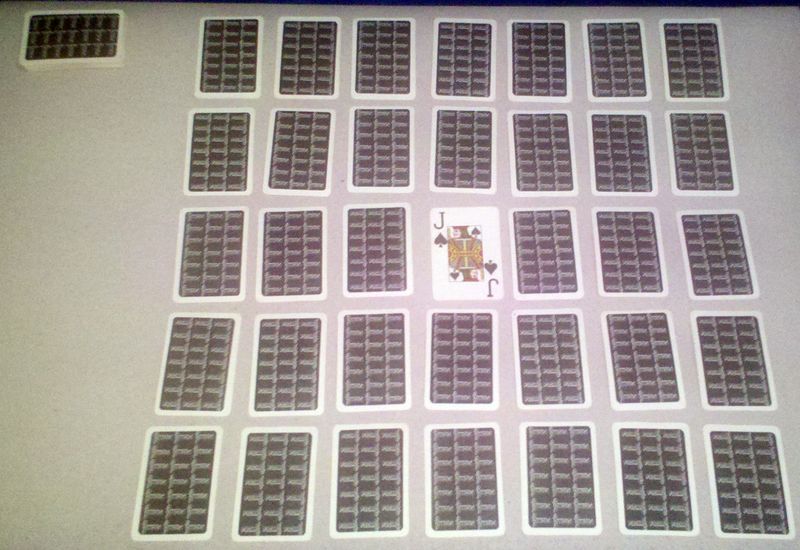
Anyway, DEG is playable by 1-8 people with a deck of playing cards, a couple of dice, and paper to take notes. You choose between four character classes (fighter, wizard, rogue and cleric) and start at the center of a 5x7 grid of cards. Your goal is to reach one of the corners to leave the dungeon, while battling monsters, avoiding traps and finding treasure. Picture, if you will, a rogue at the beginning of the game, deep in the dungeon. Each class has a special ability; rogues have a chance to automatically deactivate traps.


The game is played by turning cards to try and move your character to the corresponding position in the grid. Monster cards must be fought and traps must be disabled (both by rolling dice.) Treasure and healing potions are collected immediately. Here's my rogue facing his demise at the hands of a particularly nasty monster.

Every time your character fails at disarming a trap or in combat, he or she loses one hit point (they start with only six.) Reaching the dungeon exit is not easy, much less if you decide to explore a bit for treasure instead of running straight away. Here's my fighter, on another game, losing his last hit point on a trap, after defeating three tough monsters.

Played solo, I found "A Dungeon Escape Game" to be a nice option for a 10-minute break as it plays quickly and setup time isn't long either. It also got me thinking about other possibilities for dungeon-delving or strategy games (cards as units?) involving just a regular deck of cards and possibly some dice.

Saturday, July 21, 2012

Strangers in the Night

So I've finished reading After the Horsemen (ATH), played a few test battles and finally went for the first real game with it. In my opinion the prologue perfectly sets the tone of the game: it's all about the humans who have survived the apocalypse and now rebuild -- or prey on others.

There are a lot of small modifications to the rules to fit this gritty setting. There's a new "recover from duck back" reaction that may send grunts running for their lives. With an optional rule, figures may become out of ammo for the rest of the battle. Items, which seemed plentiful to me in 5150 New Beginnings, become very precious in an ATH campaign as your group needs food, fuel and medical supplies to survive.

In this game I went with a one-shot Wandering encounter. I created a lone wolf star called Tom (rep 5, fitness 5, people 3, savvy 4.) I got a 6 when rolling for the first attribute so I got one extra: friendly and white knight. To those, I added steely eyes. Tom's attributes made me think that his companion should be of the sheep class, so I rolled Shelly (teen female, rep 2, fitness 1, people 2, savvy 0, sure handed.) Tom carries an SMG, knife and a pair of binoculars, while Shelly has a pistol and a knife. Each of them has two units of food and one unit of medical supplies. So here I was with the typical post-apocalyptic duo of tough guy and the young girl he rescued from raiders and is teaching how to survive.


I decided that the place they are passing through has an Encounter Rating of 1 (middle of nowhere,) rolled evening for the part of day (thus reducing visibility,) and rolled for lack of sleep getting no ill effects. For the board, instead of randomly rolling terrain I simply scattered some green patches marking areas of tall grass, bushes and trees that block line of sight and otherwise work like woods in the rules. 

After placing my characters on sector 8, I rolled for the PEFs getting a rep 4 PEF on sector 1, a rep 5 PEF on sector 3 and a rep 3 PEF on sector 5. Here's the setup at the beginning of the game (I'm using small bug miniatures as PEF markers.)


Here's the battle report, with some narrative interpretation (and game commentary in square brackets):

Tom couldn't stop thinking this was a mistake. Crossing the wasteland in the dark, with some farmer girl that had never left her settlement -- until she was taken by raiders, that is. Still, they had to keep moving because the surviving raiders would come hunting for them with the sunrise.

This part of the wasteland had several patches of vegetation. The plan was to move around them, close enough to use them as cover but never stepping inside, to avoid stirring whatever might be in there. As they approached the first patch of tall grass, Tom motioned Shelly to wait. Carefully, he stepped ahead with his submachine gun ready. A large rat scurried across the dry ground and disappeared in a bush. "It's nothing, let's keep moving," he whispered to the teenager.

[On the third turn, Tom moved to a position with sight to and within 12" of a PEF (remember it's evening) but it proved to be nothing but nerves, so the group simply completed their movement.]


They slowly moved between two patches of bushes and tall grass, always pausing to hear any noises and movement around. Evening was turning into night and all was terrifyingly quiet.


[On the next turn they moved towards the center of the map, getting in range of another PEF -- again, nothing but nerves.]


Minutes later, Tom caught a glimpse of metal straight ahead. Pulling the girl to his back, he leveled the SMG and kept walking. A seemingly young man, with a mess of hair and beard, emerged from the darkness, pointing a small gun (maybe a machine pistol?) at them. The three people kept walking until they were only a few yards apart. "We're just passing through," whispered Tom, noticing that the man was looking curiously at Shelly. Long minutes passed but eventually both men lowered their guns and the stranger walked away, into one of the patches of tall grass. Tom kept standing there for some time more, until there was no more noise coming from the grass.


[On the fifth turn Tom's group activated first and moved in range of the third PEF. This time the PEF resolved as a neutral lone wolf. Tom failed on his people challenge, so the NPC became unfriendly. On the next turn, he walked into the nearby woods.]


Tom pulled Shelly's arm, signaling that they should start moving again. As they were about to turn and move away, he heard the sound of the grass leaves giving way to someone passing through, and a metallic "click." The young man had returned and, wild-eyed, raised his weapon to aim at Tom's head.


[Now here's the amazing part: on the following turn the NPC activated first and rolled an action of "move towards nearest player." This would bring him back in sight of my characters -- and an unfriendly NPC becomes an enemy in future meetings... so the lone wolf walked back to the edge of the woods and triggered an In Sight test!]


Tom crouched and fired a burst from his SMG. The young man let out a short scream and fell to his side, while letting a wild burst of machine pistol fire. Nearly at the same time, two pistol shots sounded to his left: Shelly had pulled her gun and fired at the stranger.

[Tom got two successes, enabling him to act first. He fired his SMG getting two hits and taking the lone wolf NPC out of the fight. Shelly also got one hit but that didn't make much difference.]

Tom didn't bother to check if the stranger was alive. The world was a harsh place, and it was good enough that he didn't finish him off or rob his things. Besides, all the sound and flare from gun fire was bad enough, and he didn't know how Shelly would react when she started thinking about the firefight. So he just put an arm around her back and pulled her along, moving quickly into the night.

[After the battle, my group simply had to walk to the edge of the map to complete the encounter, since there were no more PEFs to be resolved.]

Conclusion

There's a lot to like in After the Horsemen. The game moves fast (I love the sector-based movement of PEFs, also featured in 5150 New Beginnings) and keeps you on your toes. A full survival campaign is now on my "game projects" list. For now, I might try a few more games with Tom and Shelly.