Sunday, May 13, 2012

Circle of Death: Grend vs. Mambul

This is the first match in the Circle of Death tournament. Grend is a former soldier from Seniira. A few years ago two villages in his nation were ravaged and a group of beastmen was found guilty. Some of them were gladiators and were set free as long as they kept out of Seniira. Grend wouldn't have that, so he turned to the arena to hunt them down. For now he's gaining fame to be able to have his revenge, and that's the reason for him to joining this tournament. He uses his soldier training with spear and shield to keep his foes away.

Mambul is a lion man, one of the many cursed beastmen of the realm. He worked as a mercenary until he found that he could gain more (with the same risks) as a gladiator. He is known for his cruelty, using a hand axe to slowly cut down his opponents and then finish them with a vicious bite. It is no surprise that the tournament masters would match him against Grend.

[Technically, both fighters have a rating of 9 but Grend barely makes it at 85 points while Mambul has 92 points. So I chose to play Grend. Note: I use the yellow die to mark the active gladiator and the orange die to mark the current attacker.]

The gates of the arena slid down, hitting the dusty ground with a thump. The two gladiators stood at opposite sides, facing each other. Grend tightened his grip on the spear and Mambul let out a roar that made the chatter of the audience turn into silence. The former soldier knew that feeling, the growing fear right before the charge. He had to keep it in check to come out alive. Mambul wouldn't make it easy, as he shouted, "You call yourself a monster hunter, but today you will be my prey!" and started a slow, prowling walk towards the center of the arena.

Grend rushed to the center, holding the spear low and his shield straight ahead -- a defensive posture. When he was a few feet away, Mambul pounced forward with his axe. Grend attempted a rising stab with his spear but the lion man deflected it and in a continuous motion slashed again. The man avoided the attack and closed in for another stab that glanced Mambul's armor.


Circle of Death

I have decided to organize my next games of Red Sun Black Moon in a tournament campaign format. The Circle of Death is a gladiator tournament held on a small island somewhere in Talomir. The arena is small, built into a 10-feet deep pit. The audience can watch the matches along the edges of the pit, and a select few have access to a ring-shaped platform suspended over the arena.


There are eight gladiators taking part in the tournament. From left to right, they are: Grend, a warrior from Seniira; Mambul the lion man; Black Talon, a silver elf rogue; Terokk, the masked foreigner from lands beyond the horizon; Sussimog, turtle man from the dark swamps; Keris, from the red sun dwarves; Drush the savage orc; and Mad Ramos, from Mirish.


After creating the stats for each of the fighters, I randomly matched them for the first four fights. Here is the chart for the tournament. On each fight I'll control the gladiator with the lowest rating or, if they are evenly matched, I'll randomly pick one. After each fight, I'll allow the surviving gladiator to recover 2 Strength, repair bleeder wounds and roll on the recovery table once.


That's it for now. The first match of the tournament will be Grend vs. Mambul. The odds are in favor of the lion man, but nothing is certain in the arena...

Saturday, May 12, 2012

Those who are about to die

So I jumped the Red Sun Black Moon (RSBM) bandwagon, so to speak... While I frequently read the Two Hour Wargames discussion group, this title (and its older sibling, Red Sand Blue Sky) had been under the radar for me so far. Actually, what sold RSBM to me were these wonderful battle reports from Carmen's Fun Painty Time (more here and here) and every day new, awesome reports are popping up on the discussion group.

Since this game is played in an arena with sector-based movement, there is no need for a large board even if you use 28mm miniatures -- so I printed a bunch of them to use as my arena fighters. In this picture there are humans from Okum Arts, reptilians from One Monk, dwarves and elves from PERMES, the just-released lion men from Reivaj and orcs from Sanity Studios.
Here's the arena I made, drawing on a corkboard self-adhesive tile. Each of the 9 sectors in the middle is 2" wide. Later on I might add some 3D walls around it (maybe in a flat-folding format.)

While reading the rules I created a few fighters (as recommended) and staged some test battles to get the hang of the procedures. In very broad terms, the game's turns involve movement and when you end your movement in the same sector as another figure, you enter the maneuver phase. The maneuver phase models the fighters trying to find an opening in their opponent's defense and get an advantage. It is an opposed roll that may lead to an attack phase. This is similar to Qwik, but with a lot of additional details both in the test modifiers and in the outcomes. The fighters can also have several special abilities (and some negative effects, too,) referred to as signatures, which add to variety. And while you might roll some handfuls of dice at times, the game flows smoothly and welcomes narrative interpretation.

Fight!

Here's a battle report of my first complete fight in the arena. I played Karos, a red sun dwarf against Drush, a black moon orc. Dwarves and orcs have been fighting for ages, in wars, skirmishes and arenas. The corruption of some dwarven clans by the black moon cults has only increased the hatred of those faithful to the Red Sun. I counted both figures as wearing light armor (AC 1.) The dwarf used a large shield and a halberd, while the orc carried a two-handed axe. Both of them had good fighting skills and while the orc was stronger, the dwarf was a little more agile.


Monday, May 7, 2012

Orcs Strike Again (Swordplay)

Rake's Corner suffered another orc invasion, this time to try Swordplay Final Version. I controlled a raiding party of three orcs against the town militia (rep 3 or 4, warrior or missile class). I used the following custom force table to generate the militia:

Roll 1d6:
1 = rep 5 dwarf leader (medium armor, one-hand weapon)
2 = rep 4 archer (light armor, longbow)
3 = rep 3 archer (light armor, longbow)
4 = rep 4 warrior (light armor, one-hand weapon)
5-6 = rep 3 warrior (light armor, one-hand weapon)

The orcs are Bazug (star, rep 5, warrior, using a one-handed sword and shield), Crog (rep 3, warrior, with one handed axe and shield) and Dwem (rep 4, warrior, with two-handed pickaxe).

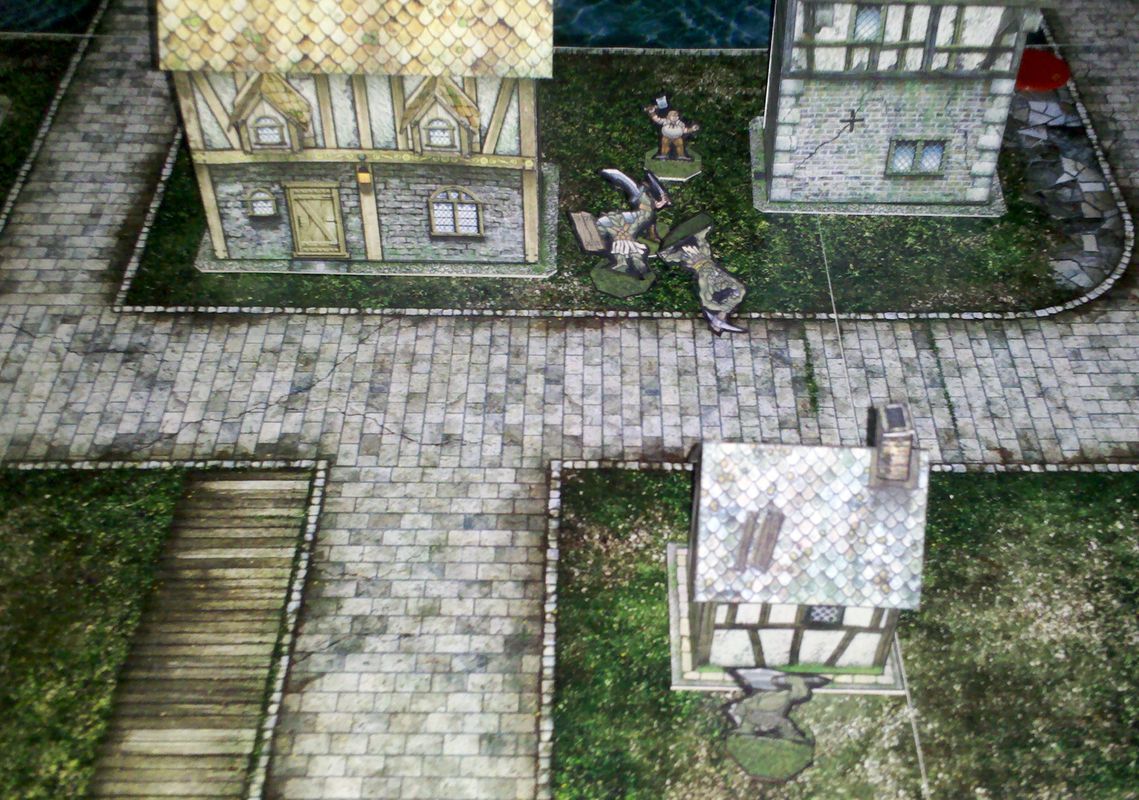
Here's an overhead view of the board. The red markers indicate the starting PEF positions. My objective is to loot the magic shop (the light-colored building on the other side of the canal.) The enemy activity level (EAL) is 3.

At the start of the battle the PEF at the center of the board moved towards my orcs and resolved as three figures: one rep 4 archer, one rep 4 warrior and one rep 3 warrior, triggering an In Sight test.

My orc leader went first, charging the human with a sword. He lost the melee round but avoided damage thanks to his star power. The archer ducked back at the same time that my orc with the pickaxe charged the swordsman. They locked in melee and, surprisingly, the orc was taken out of the fight. The other orc ducked back.

On the turn after the first combat was over, my orc leader moved forward, causing the two other PEFs to resolve and triggering an In Sight test. One PEF was nothing but nerves but the other turned out to be eight militia and dwarves. The following picture shows the troubled situation in which my orcs put themselves.

Interestingly, the five figures involved in the In Sight test rolled two successes, so all actions were simultaneous. My orc wanted to move away but the two melee fighters wanted to charge, so I rolled on the charge table and, since they got more successes, I assumed they were faster. One archer ducked back and the other missed a shot. I then proceeded to resolve the fights against the two enemies, and luckily the orc managed to take both the dwarf and the human out of the fight.

On the following turn I activated and decided to make a run towards the objective, rather than continue fighting. I left the other orc hiding behind the building, otherwise he'd probably trigger another In Sight test and die. The orc leader entered the magic shop while the enemy forces got a 6 on the initiative roll, thus being unable to activate. Now I needed two turns to loot the place. The enemies split in two groups moving around the tall building to catch my orc. He moved, triggering an In Sight test and was taken out of the fight by an archer.

As I left the shop after looting it, I triggered an In Sight test. The two archers missed and another militia ducked back. I took a fast move check and ran towards the board edge. The militia was close to surround me. I made another fast move check and started to run but caused an In Sight test. Since the orc got the most successes, he could act first and his action was to get out of the board. Victory!

Conclusion

Just like the final version of Chain Reaction, this new Swordplay has been further streamlined (in the good sense.) For instance, the new melee resolution pretty much doesn't require looking up a table anymore, and the In Sight mechanic requires less reactions as well. The armor system has changed a little, with armor class numbers that I didn't really see applied in the rules -- maybe it's something coming with Warrior Heroes: Legends?


Sunday, May 6, 2012

GunCrawl

I got the GunCrawl Collection in the recent WorldWorks sale and after seeing some nice pictures on the Cardboard Warriors forum, I had to try it. GunCrawl is a sci-fi "crawl" game for one or more players. The map is built with tiles (6"x6" rooms and different types of corridors) with grid-based movement. These features make it particularly simple to run a game using MapTool, so I wouldn't have to print and build all tiles and props first.

Here's my first mission map. The objective was to repair the two computers marked as blue squares on the map, avoiding or fighting the hostile aliens that may be found. The mission had a 20-turn time limit. I had two grunts armed with assault rifles and an engineer with a pistol. I created a single type of alien: fast-moving, with strong close-combat attacks but relatively easy to kill.
My soldiers entered the first room and found three aliens inside. The creatures charged and incapacitated one of Tom, but he recovered at the end of the turn. Afterwards they defeated the three aliens and another two that showed up in the following corridor.
By the 10th turn I had fixed the first computer and was on my way to the second objective. However, now some alien patrols started appearing. The engineer opened the door to the last room and was ripped by one of the aliens inside. Fixing the second computer without him was going to be harder.
On turn 16, one grunt was killed as the other desperately tried to fix the computer. On the next turn, he managed to complete the repairs, completing the objectives of the scenario. I didn't keep playing but I don't think he would be able to escape alive.

Conclusion

My first game of GunCrawl was interesting. The beginning was easy, maybe because my map didn't have suitable corridors to allow placement of patrols (at least until I passed through the second room.) Also, I didn't use the rules for ammunition, which would have limited the amount of ranged attacks I could make in a turn. On the other hand, near the end of the game I would repeatedly roll new enemy reinforcements that slowed me down. I still have to experiment with the threat level system for balancing the number of enemy units on the board.

I felt that the rules for GunCrawl are simple and easy to memorize. They're also very flexible, and can be adapted to sci-fi, zombies, killer robots etc. Generally, all-out aggressive enemies will be well modeled by the rules. Differently from other tile-based crawls, in this game you set up the whole board in advance. This has the drawback of requiring some planning but at least there is no risk of getting stuck in a dead end.